We have met with a district education official and he has offered to take us to some local schools to talk to teachers about eye care and students. Any doubt that he would be willing to guide us and translate disappeared when he found out we had transportation. It was our golden ticket.
We meet him at his office at 7:30 am to meet with the executive district official before embarking. We are eager with anticipation to get underway and start our research. We are going to spend two days visiting schools. We are thankful that permissions have been granted, the visits arranged so quickly, and that the education officer, Mr., Fundah, is able to accompany us since our local manager is away on other business.
We had all kinds of questions about how to identify and screen children for eye care issues. We had spent weeks researching online and poring over reports on the issues and barriers for students to get spectacles. We had explored potential tools or solutions to help overcome those barriers and issues.
We had our background questions in mind, some specific questions about work already done ready to be ask, and some new approaches to test with the teachers. One of the approaches included the option to use an app or computer to screen students instead of using labor intensive and unavailable optometrists (there is currently a huge deficit in trained optometrists in the region.)
We pull away and being the journey to the schools. The way is largely paved due to recent infrastructure improvements, but the last kilometers are packed red dirt roads.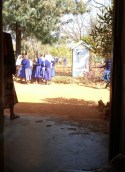
There is a painted cement marker with the school name (I recognize schule in the name—apparently a vestige of when it was German East Africa.) that marks the entrance. We pull into the school, which is a collection of single-story buildings scattered among the grounds. Groups of primary school students in bright blue sweaters move with the energy of children anywhere. There are some girls in Hijabs, an indication of the growth of Islam in the interior here.
We are ushered into one of the buildings with the headmaster and one of the specialist teachers, who was trained to screen students by another NGO. Again introductions and formalities. An explanation of the project.
I look around . This is my first time in an African school. I try to drink in every detail. Not just out of curiosity, but to see what tools and equipment would be available to help us.
There isn’t much to see. A desk. Chairs. A solid cabinet that looks like it locks. A board that appears to have years’ worth of scores, attendance figures, and other data in raw numbers and Swahili that I can’t guess at their meaning. Painted walls and wooden beams that expose the roof.
There isn’t a computer. No light switches. No light except for that which comes in from the window and the door. I l look further and see that there is no electricity.
We talk to the headmaster and the teacher about the difficulties of eye care in students. About the training done that wasn’t followed up with anything else. I can see the school children hiding beyond the door, peeking in. Others are straining to see us through the window. Complicit in their game, Helen and I give small waves and smiles. They instantly break into wide smalls and the noisy chatter of pure joy that is unique to children.
The conversation done, we exit the building. The school children have been assembled in a huge sea of blue broken up by the white caps of the hijabs. We stand in a line like a row of dignitaries, taking turns stepping forward to introduce ourselves. Then, like the dignitaries we are not, we are whisked off into our truck and onto the next location.
The second school has the distinction of having electricity. Otherwise, the issues are the same and the difficulties just as immense. The remaining three schools we visit don’t have any electricity either.
The one thing they have in abundance is hospitality. We are always offered lunch by the schools we visit during the midday.
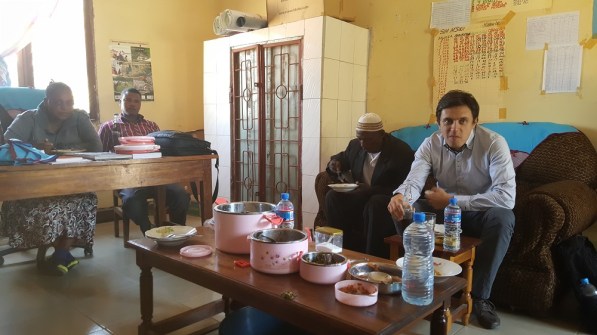
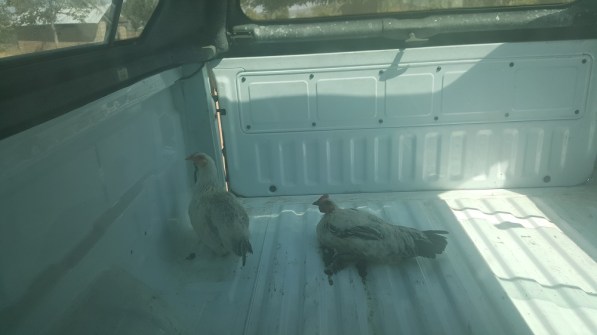
At a school with an energetic female headmaster (in the photo above), we are shown the school garden ripe with bananas and papayas before being welcomed into her home to further our conversation. At another school, we are offered papayas to take home before I can give them a paltry bag of pencils. It was perhaps bad timing, because then there was a rush of voices, and suddenly a few boys holding two chickens appeared at the door. The headmaster offered them to us to take home. We couldn’t refuse them although they needed them far more than we did. (we were able to re-gift them to our driver and school official (who I trust found a much more suitable use than we could have done).
Understandably, eye care isn’t their priority. Teachers don’t think that there is much of a problem. Even among the teachers trained b the other NGO, only the most extreme cases are viewed as being a problem. Some have forgotten their training and would like a refresher from us—something we can’t give.
There are many issues to be addressed. And one issue that hits a bit close to the bone. We always asked what they would recommend doing and what questions that they have. One of the headmasters asked if we would be back. Politely, but directly, he said that many NGOs come and go, and then they are forgotten. Would we be back? We nodded yes. Luckily, while we are here for only three months, the NGO has a four year program here. Otherwise, it was a question I wouldn’t have wanted to have answered him.


 Tanzania Sight