When I found out that we were going to be based in Singida, Tanzania, I did what I always did when traveling to a new place. I googled it. The results came back a bit bare. Usually TripAdvisor and Lonely Planet were good resources to check. I did some further googling related to them. Still rather bare. However, Lonely Planet did have the following advice to offer:
There’s no compelling reason to do more than pass through Singida en route between Mwanza and Dodoma, but there is a pretty lake and a dusty museum if you find yourself with an hour or two to kill.
TripAdvisor offered two hotels reviewed and one restaurant so that was not much more help. The most positive review was that one hotel was the best of what was available. I did find some information about the place we were going to stay, the Catholic Diocese Social Learning Center. There were pictures. I saw that there were western toilets. I was happy.
What was obvious was that it was remote.
That was driven home (pun intended) when we met with the team in Dar Es Salaam and planned our trip to Singida with Alex. It would be a 14 hour drive. Alex cheerfully positioned it as a good way to be introduced to Tanzania by driving halfway across it. I am not sure he fully bought into the idea himself since he had originally proposed flying to Singida—which actually meant flying into the closest airport to Singida and then driving 5 hours. But, the decision had been made and we would be driving on an epic road trip condensed into one day.
We were to leave at 5:30 am to avoid the buses and other traffic leaving Dar Es Salaam. It would also allow us to minimize the time driving in the dark.
Because we would be traveling with several other members of the NGO, we would travel in two vehicles—whether it was a Toyota Land Rover, or the newly purchased Ford Explorer truck (with backseats) seemed to be unclear. The Toyota Land Rover is the preferred choice for NGOs here and carries a certain status. The local team seemed to want the Land Rover.
We awoke very early in the morning. We thought we had checked out the night before to ensure a speedy departure, but something was lost in translation. I hauled my three bags out including the addition of a bottle of Absolut vodka and South African sparkling wine purchased at the duty free in Johannesburg (no sense in taking chances) and everything was loaded into the first Ford truck while we checked out. Paperwork was printed out, and more paperwork was printed out. Paperwork was signed, and more paperwork was signed. Dinner from the hotel was paid and we were now actually checked out.
We ventured out into the lingering darkness and joined the parade of cars, trucks, and buses exiting the capital. Dar didn’t look much different in darkness than in light. We followed a main road out towards the countryside, where we met the second truck at a gas station. We both sped away and my truck quickly out sped the other one with my other coworkers.
The road was quite good. Actually really good. It was better than many American roads. It was fully paved, smooth and well-marked. Outside the towns and villages, we sped along at around 100 to 120 km/hour. Approaching populated areas (which was quite frequent) they had a rumble strip followed by a large bump to force the cars to slow down to the posted 50 km/hour. There were often police checkpoints to check registration and safety equipment including a fire extinguisher and hazard triangle. It all seemed to be on the up-and-up and really designed to reduce accidents rather than line pockets.
Our first stop was for breakfast in Morogoro and to check out a local hospital. Approaching 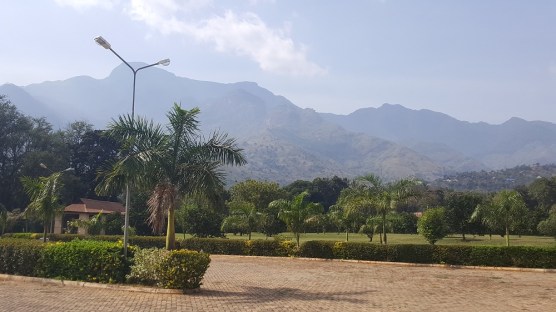 town, small mountains appeared, and the scenery became noticeably greener and more tropical. It was quite lush and beautiful. We turned off the main road for a towards the hotel compound. A quick detour t to the local regional hospital was organized, where we picked some of the local health care workers that were part of the NGO team. I did notice that there was a building funded by Sweden and another by Helen Keller International, but we didn’t spend much time in the hospital to check it out. Arriving into the hotel , we entered a grand space that was sparsely furnished. We had a serviceable buffet breakfast and I suspect we wore out the health care workers with our questions.
We resumed our journey and outside of a few pit stops and a late lunch in the new capital of Dodoma, the rest of the day stretched towards dusk. Had we been in the US, there would have been roadside attractions designed to pull travelers off the road and spend their money in tourist straps that were only marginally better than nothing, but here there were women from subsistence farms selling tomatoes and potatoes out of dusty buckets in a long line just off the road. Small children were selling packets of nuts and other small items that would run along-side the truck as it slowed down to go over the bump placed before each village.
I wondered at the pure inefficiency and impractical nature of this business, but then I suppose that is the very definition of subsistence farming.
 As dusk approached, I could sense that we were close to Singida. We had to be. I could taste it. Or perhaps it was just the red dust that I tasted that was everywhere. However, that red dust proved to be magical as the sun was setting and we pulled off at the top of a hill to look at my first real African sunset of the massive glowing red sun that you see in the National Geographic specials.
Finally, we crested another hill and saw the lights of Singida down below. Finally, after 14 hours exactly we were arriving into Singida town at 7:30 pm.


 Tanzania Sight